- Introduction
Digital is an essential element of accounting. The advent of digital economy will inevitably have a certain impact on traditional accounting. AI, big data, cloud computing, and other technologies have developed rapidly. Accounting has seen an increasing dependency on technology in recent years, and specifically software, within their clients and the accounting firm (AccountingWEB, 2019). The digital economy brings about enterprises’ financial transformation and puts forward new requirements for accounting personnel’s professional ability.
- My Experience
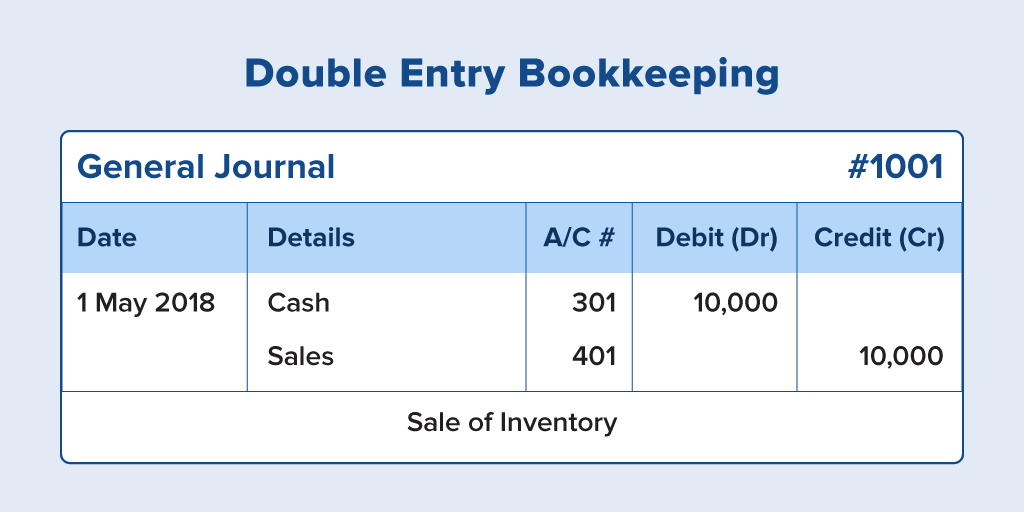
Last year, I had an internship in an accounting firm. As far as the basic double-entry method of accounting is concerned, when I studied in school, we need to determine for ourselves which accounting subjects and entries should be put in this transaction. This step is very time-consuming and if classified wrong will have a great impact on subsequent preparation of financial reports. However, during my internship, I just inputting natural language into the system will form corresponding accounting subjects and entries, which will be used for subsequent management operations. Besides the financial sharing centre is also widely used, which can centrally handle accounting operations in different locations of the enterprise. And the input data will be saved automatically, you can call it up to view at any time, employees’ work is no longer geographically restricted. In doing so, not only relieve humans from this tedious work but also improve work efficiency and reduce the incidence of errors.
- Current Situation
It must be admitted that the digital economy has brought a lot of help to the accounting industry, improved work efficiency and accuracy. Nowadays, complex and cumbersome accounting work is gradually being replaced by financial robots. The focus of accounting will shift to management work that participates in forecasting and decision-making, provides strategic support, and creates value (Lawson, 2019). However, many grassroots accountants are worried about whether they will lose their jobs because of the development of technology. Actually if do not upgrade professional skills, it will eventually be eliminated by society. After all traditional professions have gradually disappeared, and new professions have been born.
As far as the accounting industry is concerned, the status quo is that some large companies have already begun to enjoy the convenience and high efficiency brought by the digital economy. For example, “Big Four” accounting firms already have their own financial robots (Iacone, 2019), while some small and medium-sized enterprises still maintain traditional accounting methods because of funding problems or fear that employees cannot adapt to the changes.
- Future Development
McKinsey & Co. Global Institute’s research on automation technology and its potential impact shows that 42% of the company’s financial activities (such as cash outflows, receivable management, taxation, risk management, etc.) can be fully automated through the use of mature technologies and 19% can be nearly fully automated (Plaschke, Seth and Whiteman, 2018).
Nowadays, digitalisation for professions has become a necessity rather than a choice. Therefore, companies that do not implement digitalisation in the future will eventually be eliminated. More software will be developed in the future to solve tedious and repetitive accounting tasks and more and more enterprises are using digital tools to enhance products or service quality and facilitate compliance that will help manage engagements more efficiently (Journal.isca.org.sg, 2019).
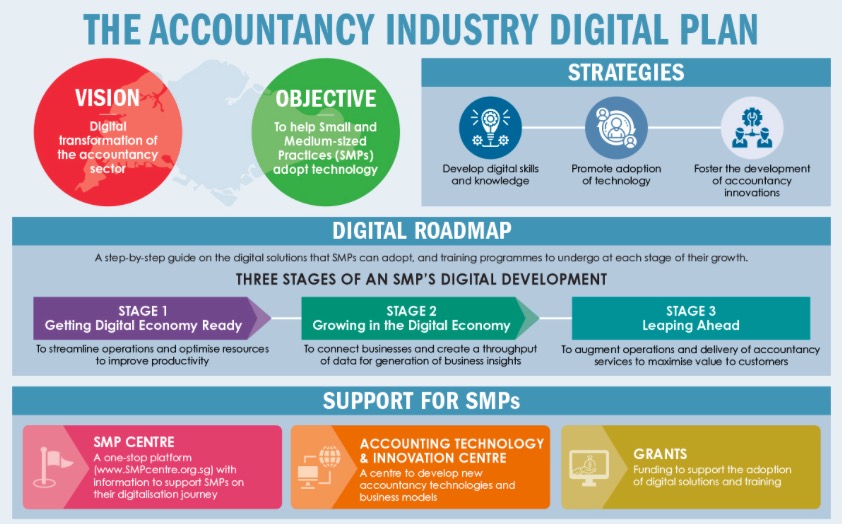
Future accounting work requires that accounting personnel be proficient in accounting, establish a business-finance integration thinking, strengthen the accumulation of corporate management capabilities, and be able to use financial data to support organizational budget forecasting, risk management, financial planning, and performance control. That is, accountants need to have the ability to management accounting.
- Conclusion
The accounting industry has gradually achieved digital management during the iterative upgrade. The basic accounting functions that are simple and highly repeatable in traditional accounting operations have gradually been replaced by intelligent machines. The positioning of the accountant has shifted from review and check to business, management, and strategy transformation of “value creators”, accounting talents face multiple opportunities and challenges for transformation training and capacity upgrading. With the development of the digital economy, the number of the low and middle-level financial accountant can be reduced, but high-end financial accountant and management accountant are still hard to be replaced for a long time, especially its strategic thinking and communication skills can play an irreplaceable role effect.
- Reference
AccountingWEB. (2019). How the digital age is changing accountancy. [online] Available at: https://www.accountingweb.co.uk/community/industry-insights/how-the-digital-age-is-changing-accountancy.
Iacone, A. (2019). Bots, Data, AI—Part of Retraining the Big Four’s Workforce (1). [online] News.bloombergtax.com. Available at: https://news.bloombergtax.com/financial-accounting/bots-data-ai-part-of-retraining-the-big-fours-workforce-1.
Journal.isca.org.sg. (2019). SERVICES 4.0 (PART 3): ACCOUNTANCY INDUSTRY DIGITAL PLAN BOOSTS DIGITALISATION EFFORTS OF SMPS. [online] Available at: https://journal.isca.org.sg/2019/08/29/services-4-0-part-3-accountancy-industry-digital-plan-boosts-digitalisation-efforts-of-smps/pugpig_index.html
Lawson, R. (2019). A look at the next 100 years of management accounting. [online] Accounting Today. Available at: https://www.accountingtoday.com/opinion/a-look-at-the-next-100-years-of-management-accounting.
Plaschke, F., Seth, I. and Whiteman, R. (2018). Bots, algorithms, and the future of the finance function. [online] McKinsey & Company. Available at: https://www.mckinsey.com/business-functions/strategy-and-corporate-finance/our-insights/bots-algorithms-and-the-future-of-the-finance-function.
 Live well, love lots, and laugh often
Hi Vicky!
I personally thought this was a very interesting piece on the accounting industry as my graduate job is with an accountancy firm here in Exeter. It was particularly fascinating reading about your experience as an intern at an accounting firm and how you witnessed the impacts of the digital economy on the changing the role of the accountant first-hand.
You mentioned that the current situation of professional accountants is that they are gradually being replaced by financial robots. I was wondering whether you have considered the impacts of the likes of QuickBooks for small businesses and the self-employed? This video briefly shows some of the services QuickBooks offers their users, which arguably eradicates the need for their users to engage with an accountant in person. Hence, I would agree with your statement that accountants need to develop their skill set to move beyond their generic role and move more towards providing advisory services and strategic support for their clients.
You conclude stating that traditional accounting operations have gradually been replaced by machines which is of no surprise as accountants and auditors are the second highest at-risk roles from the digital economy (Nagarajah, 2016). Resulting in even the Big 4 seeing an adverse impact on their hiring practices (Nagarajah, 2016). However, I do think a balance can be achieved between automation and accounting professionals as accountants skill upwards and shift to more strategic and analytical roles.
I think this is particularary important to me because as I train to become a chartered accountant, my role will see continuous change so as to enture it does not become obsolete from increasing automation.Thank you for your isnights, I found them to be very though provoking with regards to my future career.
Nagarajah, E. (2016, July). Hi, Robot: what does automation mean for the accounting profession? Retrieved February 2020, from PWC: https://www.pwc.com/my/en/assets/press/1608-accountants-today-automation-impact-on-accounting-profession.pdf
QuickBooks. (2019, December 25). Intuit #QuickBooks Online – Manage Your Business All In One Place. Retrieved February 2020, from YouTube: https://www.youtube.com/watch?v=EVORd8MnIpw
LikeLike
The impact of digitalization on accounting is certainly inevitable, companies have increased dependency on accounting software; large companies would prefer more complex applications such as Intuit QuickBooks Online whiles smaller companies opt for Zoho Books or Tully due to its simplicity and affordability. This drastically reduces the need for manual accounting practices and proven in your time of internship in the accounting firm. The fear of accountants losing their jobs to robots will be addressed by the need for accountants to operate and regulate such robots, AI can not replace all accounting work as a large part of auditors work requires professional judgement, whiles advisory work would require a great deal of emotional intelligence and situational analysis skills, qualities a robot may not be able to process yet. I, however, do not agree that companies that do not implement digitization for accounting will be eliminated, rather they would just incur additional cost and have reduced profit margins.
LikeLike